

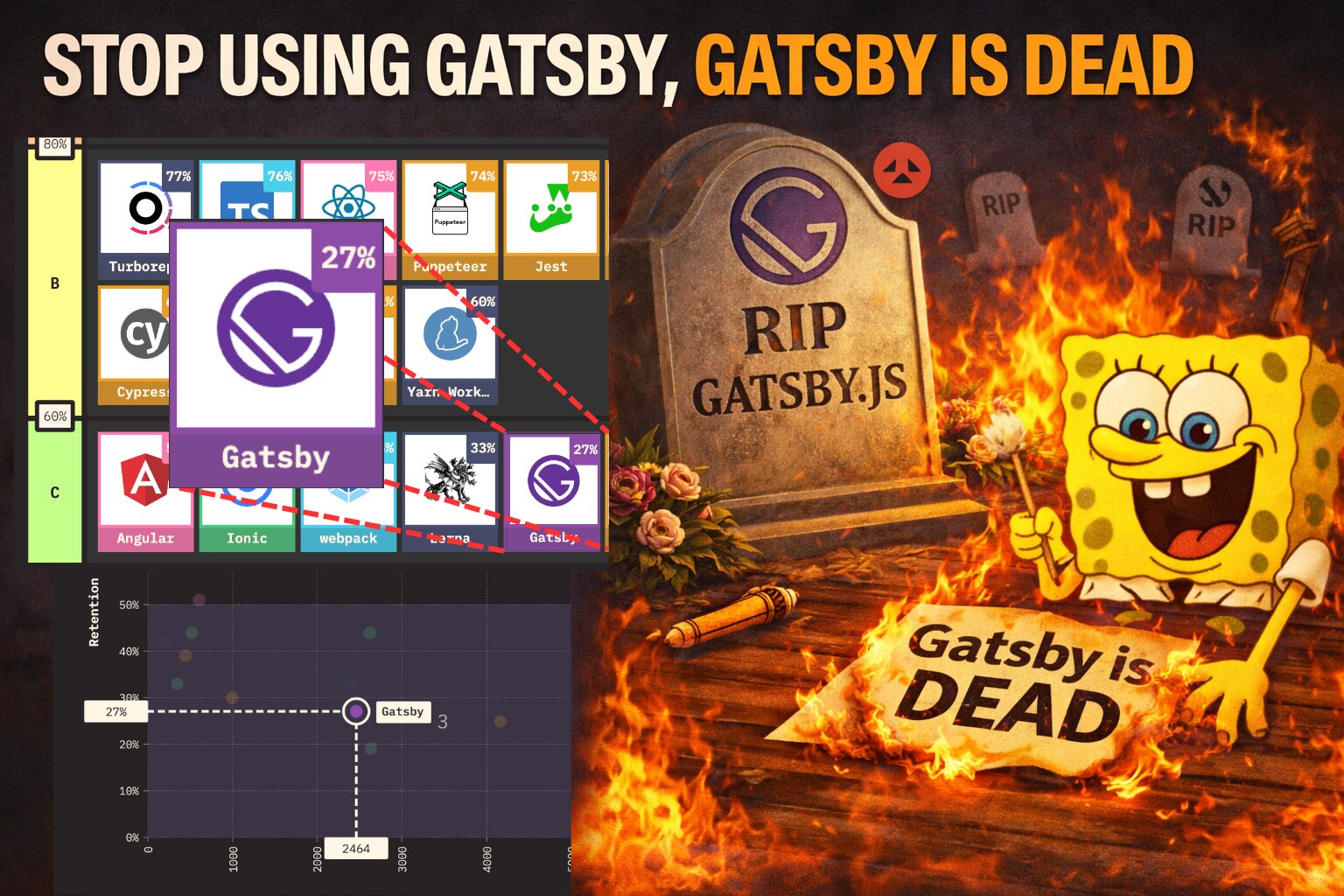
STOP USING GATSBY, GATSBY IS DEAD
Catchy Title, Eh?: Why the Problems Gatsby Solved Are Now Solved Better by Everyone Else
Table of Contents
- TL;DR
- The Numbers Don’t Lie
- My Gatsby Woes (And Why You’ll Have Them Too)
- What Killed Gatsby
- Where Everyone’s Going
- The Verdict
- Further Reading
TL;DR
Gatsby was revolutionary in 2017 with GraphQL-powered static sites and image optimization. Now? The problems it solved are better handled by Next.js, Astro, and basically every modern framework. BRUTALITY: 45% drop in downloads 1, lowest retention rate among all meta-frameworks 2, and only 1 minor update in all of 2024 3. Just don’t start new projects with Gatsby.
The Numbers Don’t Lie
I’ve been meaning to create this blog since 2020, back then planning a shiny new site powered by Gatsby for my small buisness, RookTKO, which I honestlt gave up on after weeks of configs to get everything up and running. Gatsby was legitimately revolutionary when it launched in 2017: GraphQL data layer unifying multiple sources, automatic image optimization (WebP, AVIF), code-splitting, prefetching, PWA features by default, was the framework for ambitious static sites.
I got hooked on it after seeing some of the SYNTAX podact guys use it, Wes Bos and Scott Tolinski, and I thought, “Ooooh, shiny”. And honestly, had a real bad experience with it at a company that was using it as a overcomplicated solution to a problem that really made me spazz out, so, with that in mind, I might not be the best person, as I am biased, to argue this case (Well, RIP Gatsby 2023. After Netlify swooped in, things went quiet, and the community started feeling majorly abandoned 4.), but the data is pretty clear. Or whatever, you can decide for yourself after reading the rest of this post, because honestly don’t ever believe me. But I did add links and made it concise.
NPM Downloads: 45% Decline
- February 2022 (peak): 493,000 weekly downloads
- Late 2024: 269,000 weekly downloads
- That’s a 45% drop 1
Meanwhile, Next.js added 1.6 million weekly downloads in the same period, hitting 3.95 million 1.
State of JavaScript: Lowest Retention
Check the 2024 State of JS meta-frameworks data 2. Gatsby’s retention collapsed:
- 2019: 89% retention
- 2022: 38% retention
- 2024: 27% retention (lowest among all meta-frameworks)
The survey notes: “If not for Gatsby, Next.js would be dead last” in retention, meaning Gatsby is now the least loved meta-framework 2.
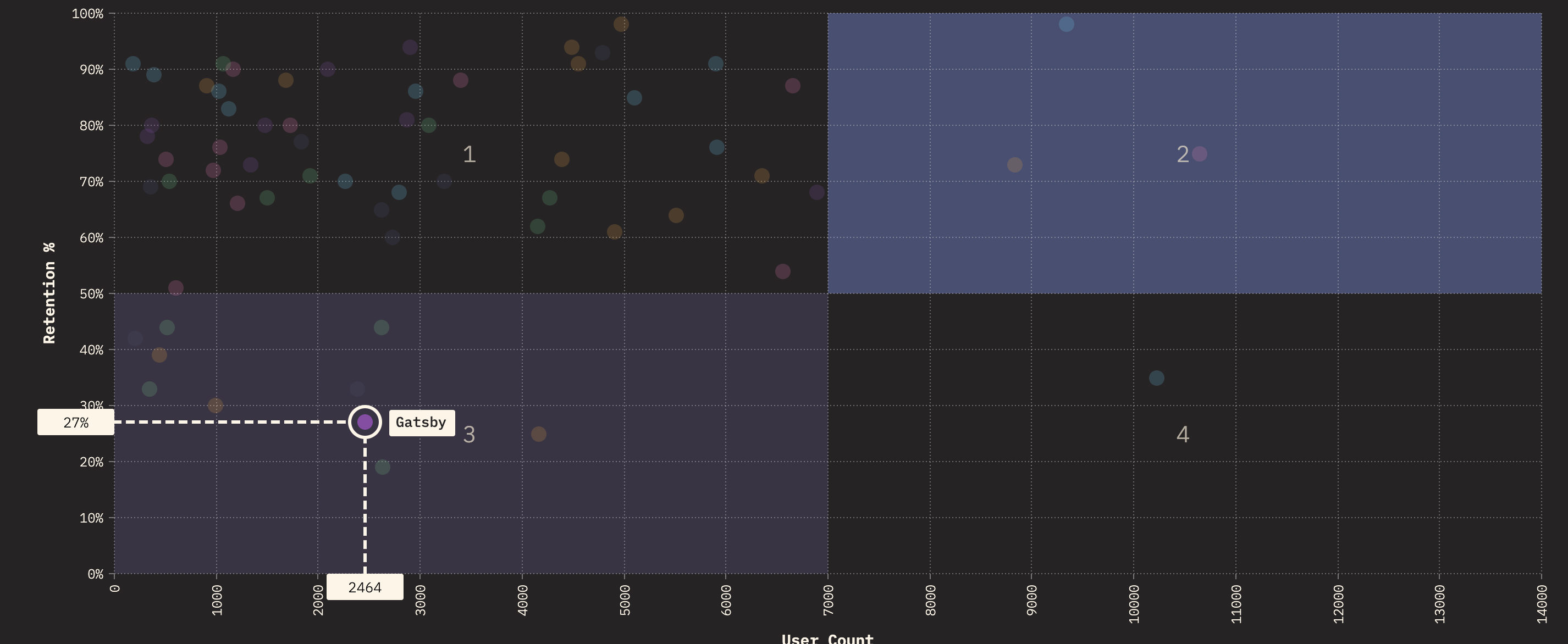 Gatsby sits at the bottom of the retention chart with just 27% of developers wanting to use it again.
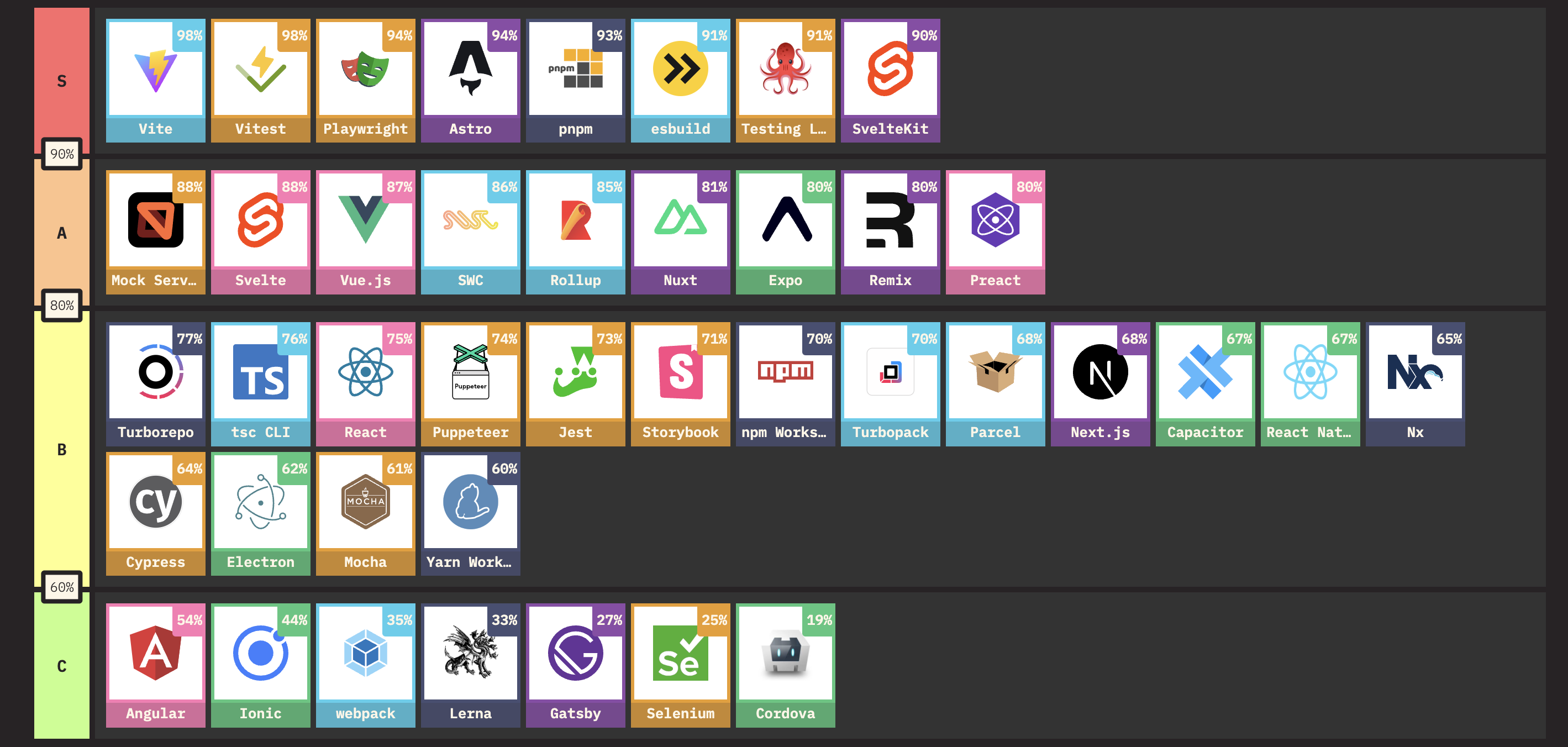 Gatsby ranks in the lowest tier (C) with just 27% satisfaction, below even legacy frameworks like Angular.
Development Activity: Flatlined
- 2024: Only 1 minor update in the 5.x branch (mostly dependency bumps) 3
- January 2025:
gatsby-starter-blog-themerepository archived and made read-only - Mid-2024: Zero commits for 24-day periods 5
A Netlify maintainer confirmed: “the current level of limited development (security fixes, limited dependency updates, low-hanging-fruit bug fixes)” is all we’re getting 4.
From GitHub discussions: “The whole staff is gone except one person” and “it would most likely NOT be supported anymore” 4.
My Gatsby Woes (And Why You’ll Have Them Too)
Upgrading Hurt
Moving from one version to another practically felt like a root canal with messy dependency conflicts everywhere. Gatsby ships with 168 dependencies compared to Next.js’s 16 6. One Reddit user 7 commented,
“I didn’t realize how many issues I’d face with Gatsby plugins until the jump from v3 to v4. It’s not worth it anymore.”
Plugin Graveyard
Many plugins went dormant. I ended up either scrapping them or writing my own from scratch. The gatsby-source-shopify plugin (10,000+ weekly downloads) was set to break in January 2025 due to Shopify API deprecation, with no timely updates 4. Another Reddit user 8 chimed in,
“Maintainers are moving on. I had to fork a few plugins just to keep them alive.”
Template 404s
So many templates have dropped off the face of the Earth, it’s like a ghost town.
Build Times That Make You Age
For a 40-page site, Gatsby takes 2 minutes 45 seconds to build. Astro? Under 50 seconds, 3.3x faster 9. Some sites reported build times of 4.8 hours before optimization 10.
Dev server startup: Gatsby 30+ seconds 6 vs Vite 500ms 6.
React Upgrades?
Gatsby v5 doesn’t even support the latest React 19 11, and the main branch commits are mostly fixes or doc updates, not real development 3. It wasn’t until v5.16 in late 2024 that React 19 got added, with caveats: document metadata hoisting disabled, Partial Hydration incompatible, community plugins not updated. Next.js and Remix had React 19 support much earlier.
What Killed Gatsby
Netlify Acquisition (February 2023)
Netlify acquired Gatsby Inc. for an undisclosed price 12. Gatsby had raised $46.8 million total. But the acquisition focused on Gatsby’s plugin ecosystem and Valhalla Content Hub, not the framework itself 12.
Post-acquisition: Gatsby Cloud sunset, mass layoffs “substantially reduced the headcount” 4, 2024 roadmap promised but never delivered, community formed Gatsby User Collective to maintain critical plugins 4.
GraphQL: From Feature to Liability
Gatsby’s GraphQL data layer was innovative in 2017. In 2024? Overhead without benefit.
Problems: “Every content change triggers GraphQL re-execution, pushing build times from seconds to minutes” 9. Type inference is “quite time-consuming” and “does not scale very well” 13. If field values are different types, “Gatsby cannot decide which one is the correct one” and schema generation fails 13.
Modern alternatives are simpler: Astro Content Collections (type-safe, no GraphQL), Next.js Server Components (direct async data fetching). Result: Developers report builds dropping “from several minutes to under a minute” after migrating 9.
Better Alternatives Emerged
Every problem Gatsby solved in 2017 is now solved better:
| Feature | Gatsby | Modern Alternative |
|---|---|---|
| Image optimization | gatsby-plugin-image, Sharp library | Next.js/Astro: Same Sharp library, no GraphQL overhead 149 |
| Data fetching | GraphQL layer for all sources | Next.js: Server Components, async/await Astro: Content Collections 149 |
| Performance | Full React hydration, 200+ KB JS | Astro: Island architecture, 5 KB JS (40x less) 9 |
| Build times (40-page site) | 2m 45s | Astro: 50s Next.js: 50s 914 |
| Dev experience | 168 dependencies, 30+ sec startup | Next.js: 16 dependencies Vite: 500ms startup 6 |
Where Everyone’s Going
Next.js: The Dominant Successor
Usage: 3.95 million weekly downloads vs Gatsby’s 269k 1 State of JS 2024: “Leads with steady growth, ~60% adoption” 2 Why: Multiple rendering modes (SSG, SSR, ISR), massive ecosystem, active development.
Astro: The Performance Champion
Build speed: 3x faster than Gatsby 9 JavaScript: 40x less (5 KB vs 200+ KB) 9 Why: Island architecture, Content Collections (no GraphQL), framework flexibility. Migration: Official Astro guide: “Migrating from Gatsby” 15
Also Consider
- Remix: Full-stack SSR, progressive enhancement, route-based data loading (no GraphQL)
- Vite + React: 500ms startup 6, minimal dependencies, no SSG/SSR overhead
- Hydrogen: For e-commerce (gatsby-source-shopify broke in Jan 2025 4)
Industry Consensus: Hard Pass
Stackademic (2024): “The short answer to whether you should use Gatsby.js in 2024/2025 is: No, not unless you’re already invested in it” 5
Smashing Magazine (2024): “Starting a new project? Gatsby should be off your radar” 6
“I’m switching away from Gatsby because it’s basically on life support,” (Reddit user) 7
The Verdict
Gatsby led GraphQL-powered static sites and image optimization between 2017-2020.
But here’s the brutal truth: Every problem Gatsby solved is now solved better by Next.js, Astro, Remix, or Vite. The data is unambiguous:
- 45% drop in downloads 1
- Lowest retention rate (27%) among all meta-frameworks 2
- 3.3x slower builds than Astro 9
- 40x more JavaScript than Astro 9
- 10.5x more dependencies than Next.js 6
- Only 1 minor update in 2024 3
For new projects: Gatsby is inadvisable. Choose Next.js for versatility, Astro for content sites, or Remix for full-stack apps.
For existing projects: If it works, keep it running, but plan your exit strategy.
Don’t just take my word for it (seriously, don’t): check the State of JS 2024 data 2, poke around Reddit 7, and read the GitHub discussions 4 yourself. Once you see how the alternatives perform (and how quiet Gatsby’s development has become), you’ll probably never look back.
Further Reading
Want to dive deeper? Here are additional perspectives on Gatsby’s decline and migration guides:
Critical Analysis
- Bejamas: “Gatsby is going down, and it’s taking your website along” - A stark warning about Gatsby’s state in 2025 16
- BCMS: “Why developers love to hate Gatsby.js” - Developer pain points explained 17
- ikius: “Is Gatsby.js dead and is this the end for them?” - Another comprehensive look at Gatsby’s demise 18
- elpuas: “Is GatsbyJS Still Relevant in 2024?” - Spoiler: not really 19
Technical Comparisons
- caisy: “Astro vs Gatsby: An In-Depth Comparison” - Performance benchmarks and architecture differences 20
Real Migration Stories
Developers who actually made the switch:
- Artem Sapegin’s migration story - From Gatsby to Astro with lessons learned 21
- Jacob Wenger: “From Gatsby gridlock to Astro bliss” - A personal site redesign journey 22
- Luciano Mammino’s experience - Technical migration guide 23
- ButterCMS: “Migrating to Next.js” - For those choosing Next.js over Astro 24
Podcast & Video Discussions
- Syntax Podcast: Gatsby Framework Discussion - Wes Bos and Scott Tolinski discuss Gatsby’s evolution and current state 25
References
NPM Trends: Gatsby vs Next.js. (2024). Download Statistics ↩︎ ↩︎ ↩︎ ↩︎ ↩︎
State of JavaScript 2024: Meta-Frameworks. (2024). Survey Results ↩︎ ↩︎ ↩︎ ↩︎ ↩︎ ↩︎
Gatsby Master Branch. (2024). Commit History. GitHub ↩︎ ↩︎ ↩︎ ↩︎
Gatsby Discussion #39062. (2023). Is GatsbyJS Officially Dead? GitHub ↩︎ ↩︎ ↩︎ ↩︎ ↩︎ ↩︎ ↩︎ ↩︎
Stackademic. (2024). Should I Use Gatsby.js in 2024/2025? Medium ↩︎ ↩︎
Smashing Magazine. (2024). The End Of My Gatsby Journey. Article ↩︎ ↩︎ ↩︎ ↩︎ ↩︎ ↩︎ ↩︎
Reddit Thread. (2023). Is Gatsby Dying? r/gatsbyjs ↩︎ ↩︎ ↩︎
Reddit Thread. (2023). Netlify Acquired Gatsby, What’s Next? r/gatsbyjs ↩︎
Strapi. (2025). Astro vs Gatsby in 2025 for Developers. Article ↩︎ ↩︎ ↩︎ ↩︎ ↩︎ ↩︎ ↩︎ ↩︎ ↩︎ ↩︎ ↩︎
Gatsby Issue #39180. (2024). React 19 not supported by Gatsby v5. GitHub ↩︎
Bejamas. (2025). Gatsby is going down, and it’s taking your website along. Article ↩︎
BCMS. (2024). Why developers love to hate Gatsby.js instead of using it. Article ↩︎
ikius. (2024). Is Gatsby.js dead and is this the end for them? Article ↩︎
elpuas. (2024). Is GatsbyJS Still Relevant in 2024? Article ↩︎
caisy. (2024). Astro vs Gatsby: An In-Depth Comparison. Article ↩︎
Sapegin, A. (2024). Migrating my blog from Gatsby to Astro. Blog ↩︎
Wenger, J. (2024). From Gatsby gridlock to Astro bliss: my personal site redesign. Blog ↩︎
ButterCMS. (2024). Migrating a Marketing Site from Gatsby to Next.js: A Technical Guide. Article ↩︎
Syntax Podcast (Wes Bos & Scott Tolinski). Gatsby Framework Discussion. YouTube ↩︎